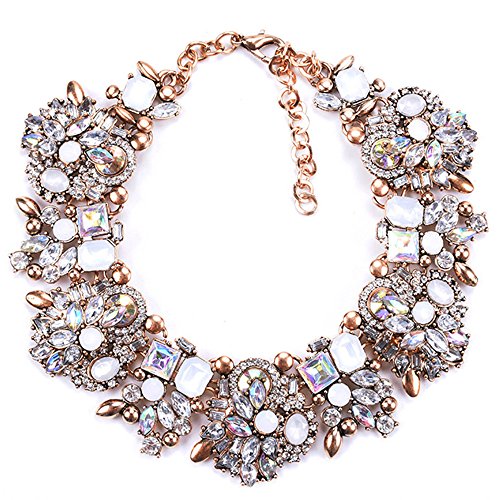
Mariah Carey’s anniversary necklace
A necklace this heavy has one job the pictures never show: staying where you put it.
Wearing: At a 25th-anniversary celebration, reported by three outlets — A heavy diamond collar sitting flat on the collarbone
Three outlets reported the necklace and all three led with the figure, which is understandable and also the least useful thing about it. The useful part is what happens when a necklace gets genuinely heavy.
A substantial collar does not hang, it sits. It rests on the collarbone and follows the bone rather than the neckline of your dress, which is why this kind of piece looks right with a plain strapless or wide neckline and fights with a collar or a high neck. If you have ever put on a big necklace and felt it was somehow in the wrong place, this is usually why: it was competing with a neckline for the same inch of space.
The practical thing nobody mentions is the clasp. Weight pulls a necklace round, so by the end of an evening a heavy piece on a small spring-ring clasp has rotated and the fastening is sitting at the side of your throat. A lobster clasp or a box clasp with a figure-eight safety holds. If you own one heavy necklace you love, having a jeweler change a weak clasp is a genuinely worthwhile twenty dollars.
And the honest note on sparkle: at a distance, in directional evening light, good lead crystal and diamond are much harder to tell apart than either industry likes to admit. What gives a cheap piece away is almost always the setting — thin claws, visible glue, a yellowish metal tone — not the stone.
What transfers
Match a heavy necklace to your neckline, not to your outfit. It sits on the collarbone and needs that space clear, so plain and wide wins and a collar loses. Then check the clasp: anything heavy on a small spring ring will rotate all evening.