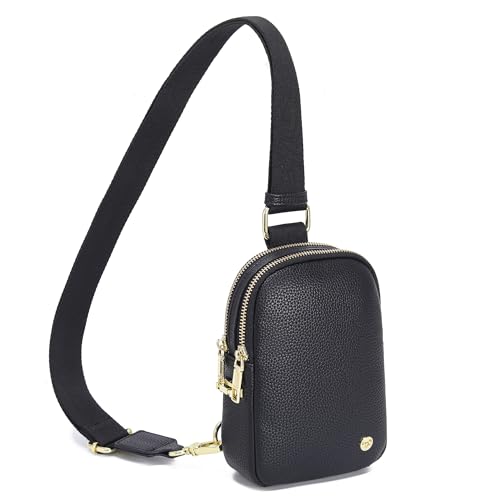
The strap is sanding one shoulder
Pilling is friction, which we have said before in the context of caring for knitwear. What gets missed is that a bag concentrates that friction on a patch a few inches across and then applies it twice a day for a winter.
This is why a sweater pills on one shoulder and nowhere else. It is not a fault in the sweater and it is not even really wear — it is one object rubbing the same spot. The giveaway is the asymmetry: check both shoulders of anything you have had a year, and if one is fuzzy and the other is not, the bag did it.
Chain straps are the worst offenders on anything knitted. A chain has edges and gaps, and a knit is a structure of loops, so the links do not rub the surface so much as pick at it. A wide, smooth strap spreads the same load over more area and has nothing to catch on — which is the whole argument for the strap style you already see on winter bags.
The free fix is to swap shoulders, which also spares your neck, and to put the bag over your coat rather than under it. A coat is built to be abraded. A cashmere sweater is not.
Read the full trend →
More on Amazon
As an Amazon Associate we earn from qualifying purchases. Prices shown were captured on the dates given and can change at any time.
The snag test that takes ten seconds
We have noted elsewhere that exposed prongs catch on clothing and work loose. What we have not given you is the way to check before a piece has eaten a sleeve.
Run it over a pair of sheer tights. That is the whole test, and it is what people in the trade have always done. Sheer hosiery is far more fragile than any knit you own, so anything that passes it is safe on a sweater, and anything that catches will find your knitwear within a week. Do it with the rough side, the underside, the clasp — every surface that will touch fabric.
The usual culprits, in order. Claw settings with the prong tips standing proud. Open filigree and anything pierced, where a loop of yarn can get inside the gap. Bracelet and watch clasps, where there is a hinge with an edge. And the join where a charm meets its jump ring, which is often left with a tiny burr.
What is reliably safe: bezel settings, where the stone is held by a continuous rim of metal, and flush or gypsy settings, where it sits level with the surface. If you wear a lot of fine knit through winter, that is the setting to buy rather than a style rule to follow.
Read the full trend →
More on Amazon
As an Amazon Associate we earn from qualifying purchases. Prices shown were captured on the dates given and can change at any time.
Sunglasses in a neckline
A small, extremely common habit with a permanent result, and worth mentioning now because the ones you wore all summer are still being pushed into a sweater on bright November mornings.
What hooking them in a neckline actually does. The two arms spread apart to grip, which stretches the rib sideways while the frame's weight pulls it down. Ribbing recovers from a little of that and not from months of it, so the neckline ends up permanently slack in a way that will not wash out. On a finer knit, the arm tips eventually work through between the loops and leave two small holes an inch or so apart — a distinctive pattern once you know to look for it.
It is worse on the clothes you care about, because fine-gauge knits have less structure to resist the spreading, and it is worse with heavier frames.
What to do instead, given nobody is going to stop doing it entirely: hook them on a bag strap, a belt or a pocket edge, or put them on your head — hair takes the stretching and does not keep the shape. If it has to be the neckline, make it a shirt placket or a sturdy crew, not the cashmere.
Read the full trend →
More on Amazon
As an Amazon Associate we earn from qualifying purchases. Prices shown were captured on the dates given and can change at any time.
Color that moves
The season's bags are deep, saturated and often suede, and dark dye on a pale coat is the one on this list that is genuinely hard to undo.
It has a name: crocking. It is dye rubbing off a finished surface onto whatever it touches, and it is worst on unfinished or vegetable-tanned leather, on suede and nubuck, and on anything freshly dyed in a strong color. Damp makes all of it worse, which is exactly the condition a bag and a coat share in November.
There is a real test and it takes a minute. Dampen a white cloth and rub an inconspicuous part of the bag — a base corner, the back of a strap. If color comes away on the cloth, it will come away on your coat. Do this with a new dark bag before you carry it against anything pale, not after.
Scarves are the other one, and the mechanism is the same. A cheaply dyed wool or silk scarf that gets rained on can bleed into a pale coat collar, which is the single worst place for it. If a scarf's color runs when you hand-wash it, it will run on your shoulders.
If the test fails, it does not mean the bag is bad — plenty of good leather crocks when new and settles down. It means carry it against dark clothes for a few weeks first.
Read the full trend →
More on Amazon
As an Amazon Associate we earn from qualifying purchases. Prices shown were captured on the dates given and can change at any time.