Winter moves everything above the collarbone
Work out what is actually visible when you are outdoors in November, because it is a shorter list than people expect. A fastened coat covers the chest, the waist and the hips. What remains is your head, your face, the few inches of collar gap, and your hands.
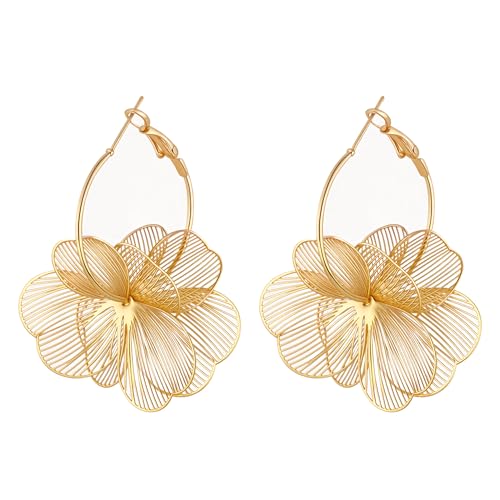
That is why earrings quietly become the main piece of jewelry for four months, and it is worth reallocating accordingly. A necklace you love is doing nothing between the front door and the office. Earrings are doing all of it, in the one zone people are actually looking at while you talk to them.
Two mechanical constraints up there, though. A raised collar or a wrapped scarf occupies the same space an earring wants: a long drop sits inside the collar gap, disappears, and catches on wool every time you turn your head. Something that sits at or just below the lobe clears all of it — a hoop with no opening, a huggie, a solid drop on a short hinge.
And scale matters more than usual because the background is now a mass of dark wool rather than skin and a shirt. A fine, pale piece against a heavy coat reads as nothing at all, which is the whole subject of the next section.
Read the full trend →
More on Amazon
As an Amazon Associate we earn from qualifying purchases. Prices shown were captured on the dates given and can change at any time.
A coat is a lot of mass, so small things vanish
This is a proportion argument rather than a taste one, and it catches people out every single year.
The coat is now the largest thing in the outfit, usually by a wide margin, and usually in one uninterrupted dark color. Against a shirt, a fine chain or a small stud is in proportion and reads as deliberate restraint. Against a couple of pounds of charcoal wool, the same piece is simply too small to register — not understated, just invisible. The piece did not change; the thing behind it did.
The fix is not necessarily bigger, it is denser. You can match mass with actual scale — a wider hoop, a chunkier cuff over the sleeve — or with repetition, which is why layering several fine chains works in winter when one does not. Three thin things read as one substantial thing.
Contrast does the same job as size. Against a dark coat, a pale or bright accessory needs far less physical presence than a dark one, because the value difference is doing the work. Gold on charcoal registers at half the size that gunmetal on charcoal does.
A note on where to put it: the one piece of torso a buttoned coat leaves you is the lapel, which we have written about separately and will not repeat here.
Read the full trend →
More on Amazon
As an Amazon Associate we earn from qualifying purchases. Prices shown were captured on the dates given and can change at any time.
A brim and a raised collar cannot both win
A genuinely physical problem with no styling solution, and it is better to know it before you are standing at a bus stop.
A brim needs clearance at the back of your head, and a raised collar is occupying exactly that space. Put them together and one of them loses: the collar shoves the hat forward over your eyes, or the brim pushes the collar flat, or you spend the walk adjusting both. This is not about whether they suit each other. The geometry does not allow it.
So pick by coat, not by outfit. With a big collar, a coat you wear turned up, or a hood, the hat has to be crown-only — a beanie, a beret, a cloche. All of them end above the nape and leave the collar alone. Save the brimmed hat for a coat you wear with the collar flat, where there is nothing behind your head to fight.
The partial exception is a brim that is shallow at the back, which some cloches and most caps have. A cap turned slightly is the one brimmed shape that coexists with a raised collar, because the peak is at the front and the back of the band is flat.
Read the full trend →
More on Amazon
As an Amazon Associate we earn from qualifying purchases. Prices shown were captured on the dates given and can change at any time.
The gap at your wrist
The last few inches of your arm are where winter outfits most often fail, and the failure is both thermal and visual.
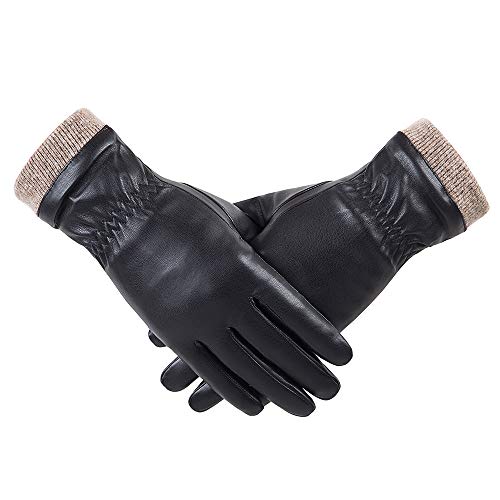
A coat sleeve usually ends at the wrist bone and a short glove usually starts there, which sounds like it should work and does not, because both move. Reaching for a handrail pulls the sleeve back an inch and opens a gap straight to bare skin at the pulse point, which is one of the fastest places to lose heat. The answer is overlap, deliberately: a glove with a cuff long enough that it is still covered when your arm is extended.
Which goes over which is a real trade-off, and worth choosing rather than leaving to chance. Glove cuff over the sleeve seals best against wind and rain and looks bulkier. Sleeve over glove is neater and gaps the moment you reach. If your coat sleeves are narrow, you may not get a choice.
And the test nobody applies: can the gloves go in your coat pocket? A pair too bulky to pocket gets put down on counters and car seats, and that is how gloves are lost — not dropped in the street, but set down indoors. A thinner glove you keep beats a warmer one you leave behind in December.
Read the full trend →
More on Amazon
As an Amazon Associate we earn from qualifying purchases. Prices shown were captured on the dates given and can change at any time.